Contemporary
Art for the Office: How to Choose Artwork for a Workplace
By Alexander van der Meer·· 10 min read
Office art is bought by one person and lived with by everyone. Here is how to plan it zone by zone, set a budget per wall rather than per print, and get a scheme past a committee without ending up with beige.
Most office art is chosen in the last week before a move, by whoever is holding the fit-out budget, from whatever is left over. You can tell. The walls end up with a stock canvas of a pebble beach in reception and nothing at all in the rooms where people spend their day.
It does not take much more effort to do this well. A workplace is not a home and not a gallery: art there has to work for visitors who give it thirty seconds and for staff who will see it every day for years. This guide is about planning for both. It is written for the person who has been handed the job — an office manager, a founder, a facilities lead — rather than for an art consultant.
Start with the rooms, not the art
The common mistake is to choose art first and then look for walls. Walk the office with a floor plan instead and give each space one job. Most offices have five kinds of space, and they want different things.
Reception and entrance: a point of view
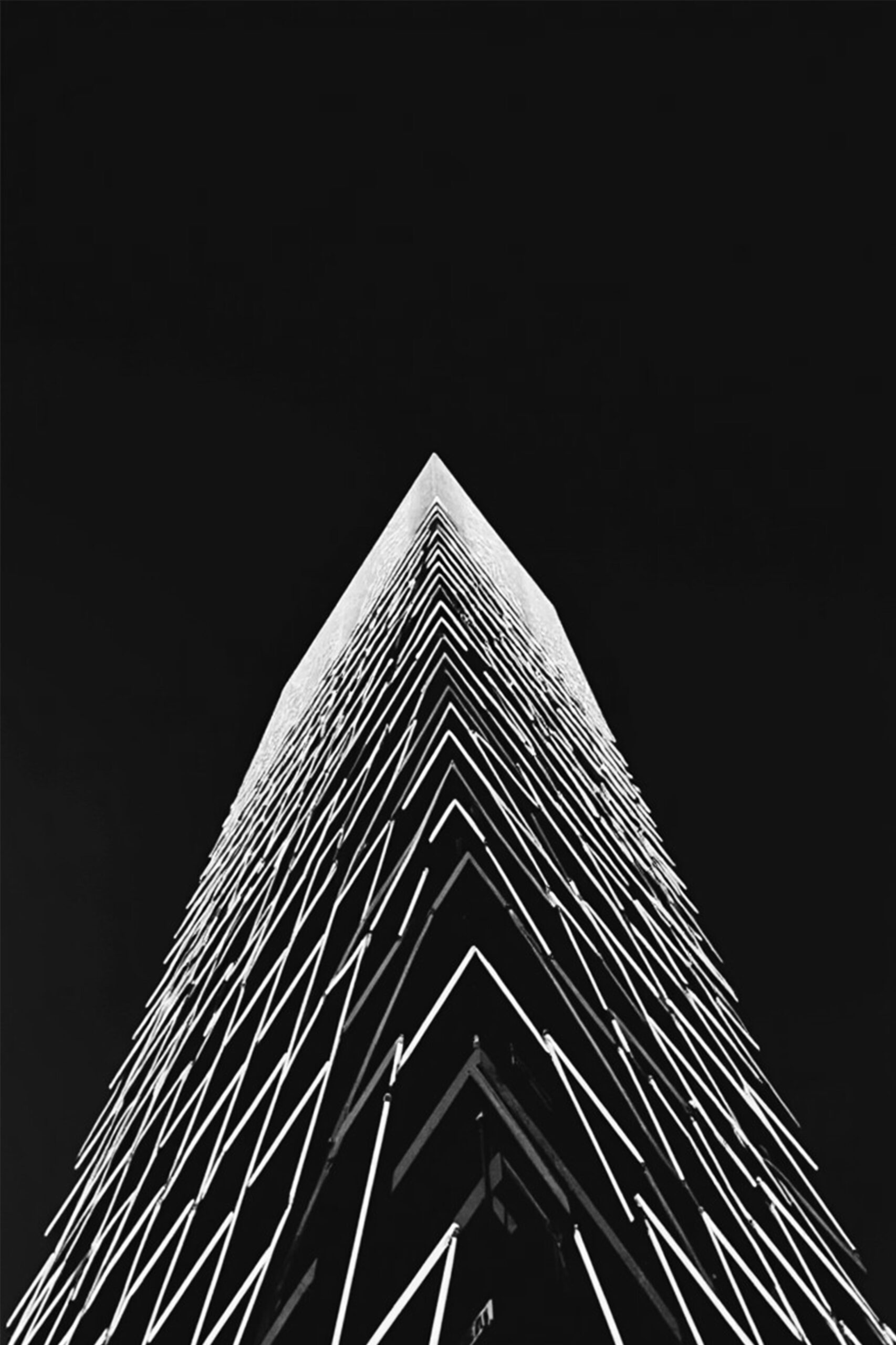
This is the one wall where art does a business job. A visitor forms an impression of a company in the time it takes to sign in, and a single confident piece says that somebody here makes decisions with care. One large work does more than five small ones, so spend disproportionately here.
Choose something legible from across the room: strong shape, clear contrast, one idea. Architecture and bold monochrome do this reliably, and they suit almost any brand without competing with the logo on the wall beside them.
Meeting rooms: calm with somewhere to go
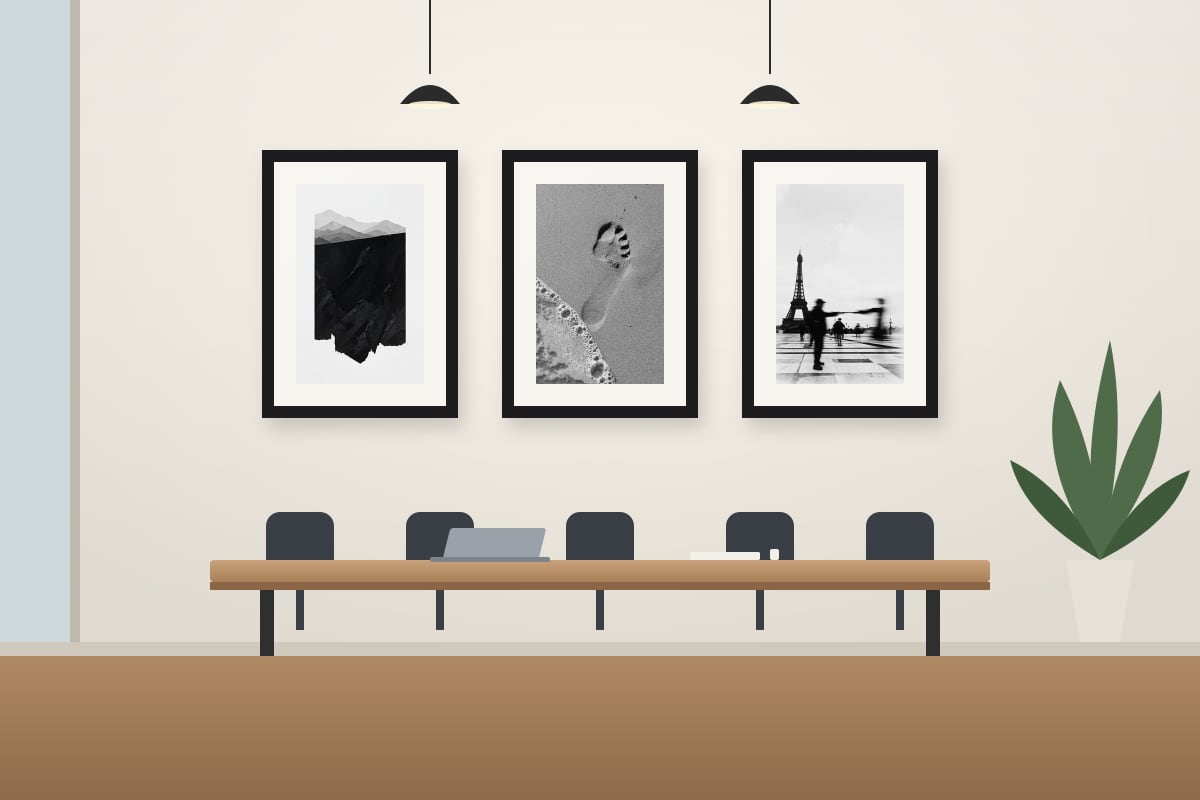
People sit in a meeting room for an hour looking past each other at the walls. Art there should give the eye somewhere to rest — a horizon, water, a mountain, a quiet geometry — without pulling attention away from the person speaking. Avoid faces, which feel like an extra person in the room, and avoid anything with text.
A set of three works hung in a row suits the long wall of most meeting rooms better than a single piece, because the wall is wide and the viewing distance is short. Our gallery-wall sets are curated in threes for exactly this shape of wall.

Open-plan desks: restraint
Where people work at desks, art should recede. Anyone who faces a demanding image for eight hours a day grows tired of it within a month. Keep contrast moderate, subjects quiet, and hang works on the walls people glance at when they look up, not directly in their line of sight across a desk.
Corridors and stairs: rhythm
Corridors are seen close up and in motion, so a sequence of smaller works at an even spacing works better than one large piece. This is the cheapest place to build a sense of identity across the floor: repeat one palette or one subject family from end to end.
Kitchen and break areas: the one place for colour
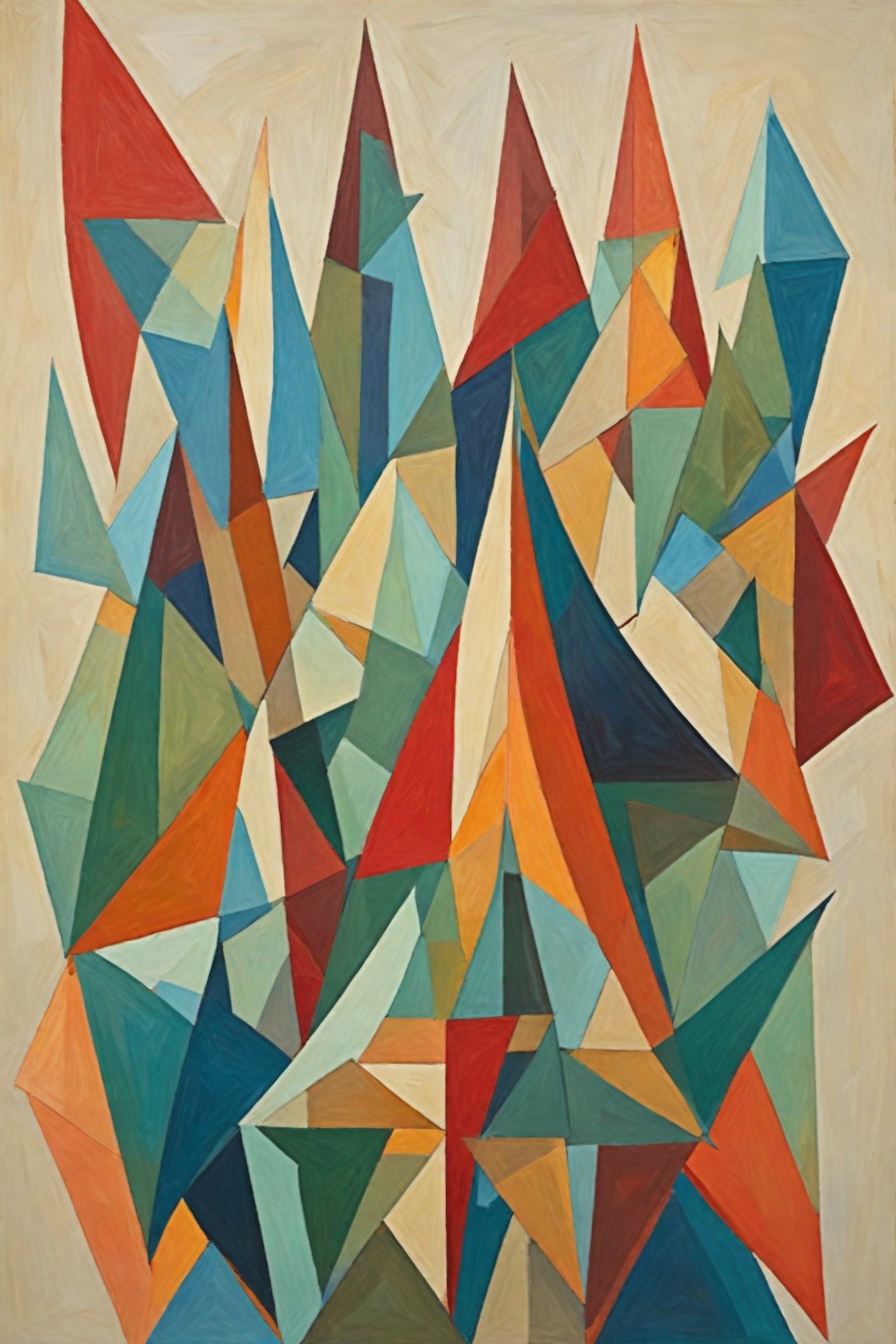
The break room is where people go to stop working, and it can carry the most colour and personality in the building. If the rest of the scheme is monochrome, this is where the bold abstract belongs.
Pick one thread and hold it
An office hung with twenty unrelated prints reads as a jumble; twenty of the same print reads as a chain hotel. The workable middle is one constraint held across the whole office and real variety inside it. Choose one of these:
- One palette — all black and white, or all within a warm range. The strongest and simplest option, and it makes framing decisions trivial. The black-and-white collection is deep enough to fill a whole floor.
- One subject family — landscape, architecture, the sea. This works well when the subject relates to what the company does or where it is.
- One sensibility — for example clean, minimalist work across media. Looser, but easier to source.
Then vary size, subject and artist freely within it. The thread is what makes a set of individual choices look like a decision.
How big, and how high
Two rules cover almost every wall in an office:
- Size the art to the furniture, not the wall. Above a sofa, sideboard or meeting table, aim for roughly two-thirds of the furniture's width — as one work or as a group with the gaps included.
- Hang the centre at about 145 cm from the floor on walls people walk past. In rooms where everyone sits, such as meeting rooms and lounges, drop it to about 135–140 cm so it sits in a seated eye line.
Our guide to hanging height and the print size guide go into the arithmetic. For reference, the works here come in two sizes, 40×30 cm and 60×40 cm, before framing; a frame with a mat typically adds 10–20 cm to each dimension.
Budget per wall, not per print
The useful question is not "how much does a print cost?" but "how much is this wall worth to us?". Reception is worth the most, meeting rooms next, corridors the least per piece. A realistic plan for a small office of fifteen to twenty people might look like this:
- Reception: one 60×40 cm work — €195–€295
- Two meeting rooms: one set of three each — €175–€255 per set
- Corridor: five 40×30 cm works in a sequence — €65–€145 each
- Break area: one or two works in colour — €95–€195 each
That is roughly €1,000–€2,000 for the art itself, plus framing, which for a dozen pieces is often a similar sum again. It is a modest line in a fit-out budget and it is the line staff and visitors actually notice. Spending on a few original, signed works also ages better than filling every wall with decor prints that will look dated in two years. If you want a framework for the overall number, our guide to how much to spend on art applies to an office as much as a home.
On tax: in many European countries art bought for business premises can be treated as a business asset or expense, but the rules differ a great deal from one country to the next. Ask your accountant before you assume either way.
Who decides: avoiding art by committee
Put a choice to the whole company and you will get the least objectionable option, which is usually the least interesting one. Asking nobody is not better — people care about what they look at every day. The approach that works:
- One person owns the scheme and chooses the thread.
- They build a shortlist of perhaps twice as many works as there are walls, all inside the thread.
- Teams vote on the shortlist for their own spaces — the meeting-room art for the people who use that meeting room.
- The owner makes the final call on reception, which is the company's wall rather than any one team's.
The shortlist does the work: whatever wins, the scheme holds together. It also gives people a reason to look at the art once it is up, which is most of the point.
Specification: making it last
Offices are harder on art than homes — more people, more cleaning, more knocks, and nobody who feels it is theirs. A few decisions at the start save a lot of replacement later:
- Acrylic, not glass, anywhere people pass close by. It is lighter and does not shatter, which matters in a corridor or a busy kitchen.
- Anti-reflective glazing opposite windows and in meeting rooms with screens, where glare is constant.
- Security fixings in public and high-traffic areas — two-point hanging or a locking plate, so works stay straight and stay on the wall.
- Keep art out of direct sun. Office lighting is on all day, every working day, which is a heavier light load than a home. Archival prints cope with that well; a south-facing wall in full sun is still a bad place for any work on paper. Our framing and care guide covers the details.
- Frame everything to one specification. The same moulding and mat across the office does as much as the thread itself to make the scheme look intentional.
Using the art in your marketing
Buying a print transfers ownership of the object, not the copyright in the image. In practice, hanging it in your office — including the reception and public areas — is fine, and so is the art appearing in the background of team photos or office tours. Using the image itself as brand material is not covered: cropping it into a website banner, printing it on merchandise or putting it on the cover of a report. If you plan anything beyond hanging it and being photographed in front of it, ask before you order; a wider licence can often be arranged, and it is a much easier conversation in advance.
Buying for an office from ArtMarket
What is useful to know if you are furnishing a workplace from this gallery:
- Every work is a signed limited edition of 25, with a certificate of authenticity stating the edition number — a real artwork by a living artist, not decor. The product page shows how many prints of each edition remain, so check before you plan a scheme around one image.
- Prints ship unframed, rolled in a rigid tube. For an office this is usually an advantage: framing locally to one specification is cheaper than shipping glazed frames and lets you match the interior.
- Delivery is free within the EU on orders over €175, which almost any office order clears, and every order has a 14-day return window.
- Order one print first if you are unsure. Hang it on the actual wall under the actual lighting before you commit to the rest; office lighting is cooler and flatter than domestic light and changes how a print reads.
For a scheme across several rooms, or to check edition availability on a shortlist before you commit to it, get in touch. It is easier to plan around what is available than to redesign a scheme around a sold-out edition. Otherwise, the full gallery is here.
Frequently asked questions
- What kind of art is best for an office?
- Art that suits the job of each space. Reception wants one strong, legible piece that makes an impression in thirty seconds; meeting rooms want calm images with depth, such as a horizon or a quiet geometry; desk areas want restraint; break areas can carry the most colour. Holding one thread across the office, such as a single palette, makes the choices look like a scheme.
- How much should a company spend on office art?
- Budget per wall rather than per print, and spend most on reception. For a small office of fifteen to twenty people, a dozen signed prints from €65 to €295 each comes to roughly €1,000–€2,000, with framing often adding a similar sum. That is a small share of a typical fit-out and the part of it people actually notice.
- Who should choose the art for an office?
- One person should own the scheme and pick the unifying thread, then build a shortlist of about twice as many works as there are walls. Teams can vote on the shortlist for their own spaces, and the owner makes the final call on reception. A shortlist inside one thread keeps the result coherent whatever wins the vote.
- How high should art be hung in an office?
- Hang the centre of the work at about 145 cm from the floor on walls people walk past. In meeting rooms and lounges where people are seated, drop it to about 135–140 cm. Above furniture, size the art to roughly two-thirds of the furniture's width.
- Can a company use art it has bought in its marketing?
- Displaying it on the premises is fine, and so is the art appearing in the background of office photos. Using the image itself as brand material, such as website banners, merchandise or printed reports, is not covered by buying the print, because ownership of the object does not include the copyright. A wider licence can often be arranged in advance.
- Should office art be bought framed or unframed?
- Unframed is usually better for an office. Framing everything locally to one specification is cheaper than shipping glazed frames, lets you choose acrylic or anti-reflective glazing where it is needed, and makes the whole scheme look consistent. Prints from ArtMarket ship unframed and rolled in a rigid tube.