Contemporary
Home Office Wall Art: What to Hang Behind the Desk
By Alexander van der Meer·· 5 min read
A home office has two walls that matter and they need different things: the one behind you, which other people see all day, and the one you face, which you see all day.
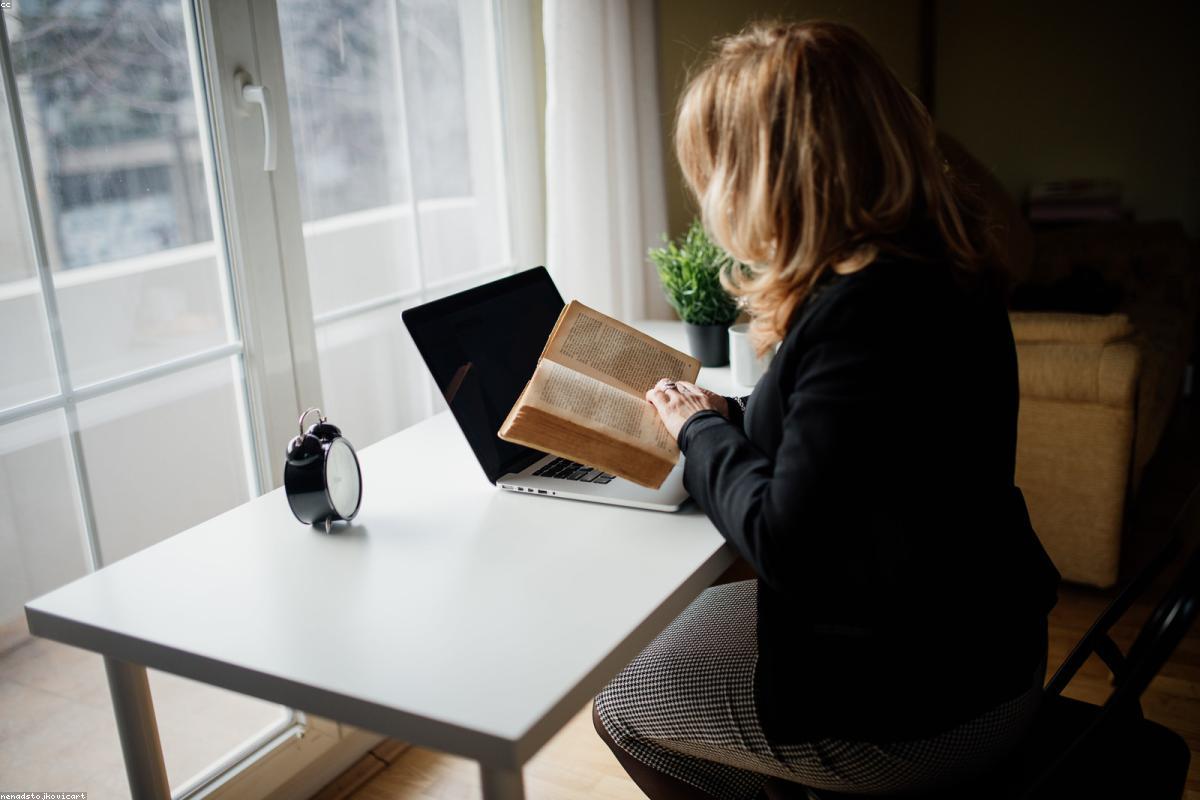
A home office is the only room where your wall is also, several hours a week, a backdrop other people study. That gives it two jobs, and they pull in opposite directions. The wall behind your chair has to read cleanly through a webcam at low resolution. The wall you face has to hold up to eight hours of direct attention without becoming either wallpaper or a distraction.
Most workspaces get decorated as though only the first exists. Here is how to handle both.
The wall behind you: what a camera can actually see
A webcam compresses hard. Fine detail turns to mush, subtle mid-tones flatten, and anything busy behind your head becomes visual noise that pulls focus off your face. What survives compression is simple shape and clear tonal separation.
Rules that hold up on camera
- One piece, not a group. A gallery wall behind you reads as clutter at 720p. If you want several works in the room, put them on a different wall.
- Offset, not centred. A print centred directly behind your head looks like it is growing out of it. Place it so it sits over one shoulder, filling a third of the frame at most.
- Big enough to survive the crop. A camera typically shows about a metre of wall. Anything under roughly 40×30 cm reads as a postage stamp — 60×40 cm is a more reliable minimum on the camera wall.
- No text, no dense pattern. Typography is unreadable and distracting in equal measure; repeating pattern produces moiré artefacts on video.
Subject-wise, architecture and structured abstraction do this best: strong lines, few elements, obvious composition. Cityscapes and architecture and minimalist work are the two edits that consistently read well on a call. Monochrome is the safe default because it cannot fight with whatever you happen to be wearing.
The wall you face: depth without drama
The wall in front of your desk is the one that affects how the work actually feels, and it needs the opposite quality. Here you want a piece with somewhere to go — enough depth that glancing at it for ten seconds is a genuine break, not enough incident that it keeps calling you back.
In practice that means images with a horizon, a recession, or an internal structure to follow: quiet landscape, water, mountain, architectural perspective, or abstract work built on a clear underlying geometry. Our home office edit is filtered for exactly this — clean lines and readable structure rather than statement colour.
What to avoid facing you all day: anything with a face in it, anything highly saturated, and anything you bought because it was impressive rather than because you like looking at it. In a living room a statement piece earns its place in ten seconds a day. At a desk you get the same image for six hours, and the loud choice ages fast.
Sizing to the desk
The two-thirds rule applies to desks the same way it applies to sofas. Art hung above a desk should span roughly two-thirds of the desk width:
- 120 cm desk: about 80 cm of art — one 60×40 cm piece reads slightly small, a pair covers it well
- 140 cm desk: about 95 cm — a pair of 60×40 cm works with a 6 cm gap lands almost exactly right
- 160 cm desk: about 105–110 cm — a trio, or one large piece if you have one
Leave 25–30 cm between the desktop and the bottom of the frame. Any tighter and a monitor or a lamp cuts into the image; any looser and the art detaches from the desk and floats. If you use a monitor arm or a tall screen, measure from the top of the screen instead — art that disappears behind a display is money on a wall nobody sees. The size guide covers the same maths for shelves and consoles.
Glare is the practical problem
Desks sit near windows and under overhead lights, which is the worst case for glazed frames. A print behind ordinary glass, opposite a window, is a mirror for most of the working day.
Three fixes, in order of cost: hang the piece on a wall perpendicular to the window rather than facing it; use anti-reflective or matt glazing; or choose a work you can frame unglazed. Mixed-media pieces printed as giclée on canvas are often float-framed without glass, which removes the problem entirely and keeps the surface texture visible — our guide to print processes explains when that is the better call.
Keep the art separate from the utility
The fastest way to make a workspace feel chaotic is to mix art with function on the same wall: a print, then a whiteboard, then a calendar, then a shelf of cables. Give the utility wall to utility and let one wall be purely visual. The contrast is what makes the room read as considered rather than assembled.
Rented flat, or a wall you would rather not drill? Lean a piece on a floating shelf or along the back of the desk. It reads as intentional, and on camera a leaning print with a shallow shadow behind it looks better than a badly hung one.
The short version
- Behind you: one piece, offset over a shoulder, simple shapes, 60×40 cm or larger, no text.
- Facing you: depth rather than drama — landscape, architecture or structured abstraction.
- Above the desk: two-thirds of the desk width, 25–30 cm clearance above the desktop.
- Check the window angle before you buy glass.
- Give the art its own wall; keep whiteboards and shelves on another.
Every work in the gallery is hand-signed, produced on premium photographic paper and shipped unframed and rolled, so the framing and glazing decisions that matter most in a workspace stay yours to make. Prints start at €65, and EU delivery is free over €175 — which is roughly where a pair for the desk wall lands.
Frequently asked questions
- What should I hang behind me for video calls?
- One piece rather than a group, offset so it sits over a shoulder instead of directly behind your head, with simple shapes and clear tonal separation. Architecture, minimal abstraction and monochrome survive webcam compression; text and dense pattern do not.
- How high should art hang above a desk?
- Leave 25–30 cm between the desktop and the bottom of the frame. If you use a tall monitor or a monitor arm, measure the clearance from the top of the screen instead, so the artwork is not hidden behind the display while you work.
- What size art works above a desk?
- Aim for about two-thirds of the desk width. A 140 cm desk suits roughly 95 cm of art, which a pair of 60×40 cm prints with a small gap covers almost exactly. A single medium print above a wide desk usually reads as undersized.
- How do I stop glare on framed art in a home office?
- Hang the piece on a wall perpendicular to the window rather than opposite it, use anti-reflective or matt glazing, or frame a canvas giclée unglazed. Ordinary glass facing a window reflects for most of the working day.