Premium Photos
Art Print Sizes: A Practical Guide to Choosing Scale
By Alexander van der Meer·· 6 min read· Updated
Which print size actually fits your wall — standard dimensions in centimetres, room-by-room recommendations, and how mats and frames change the final footprint.
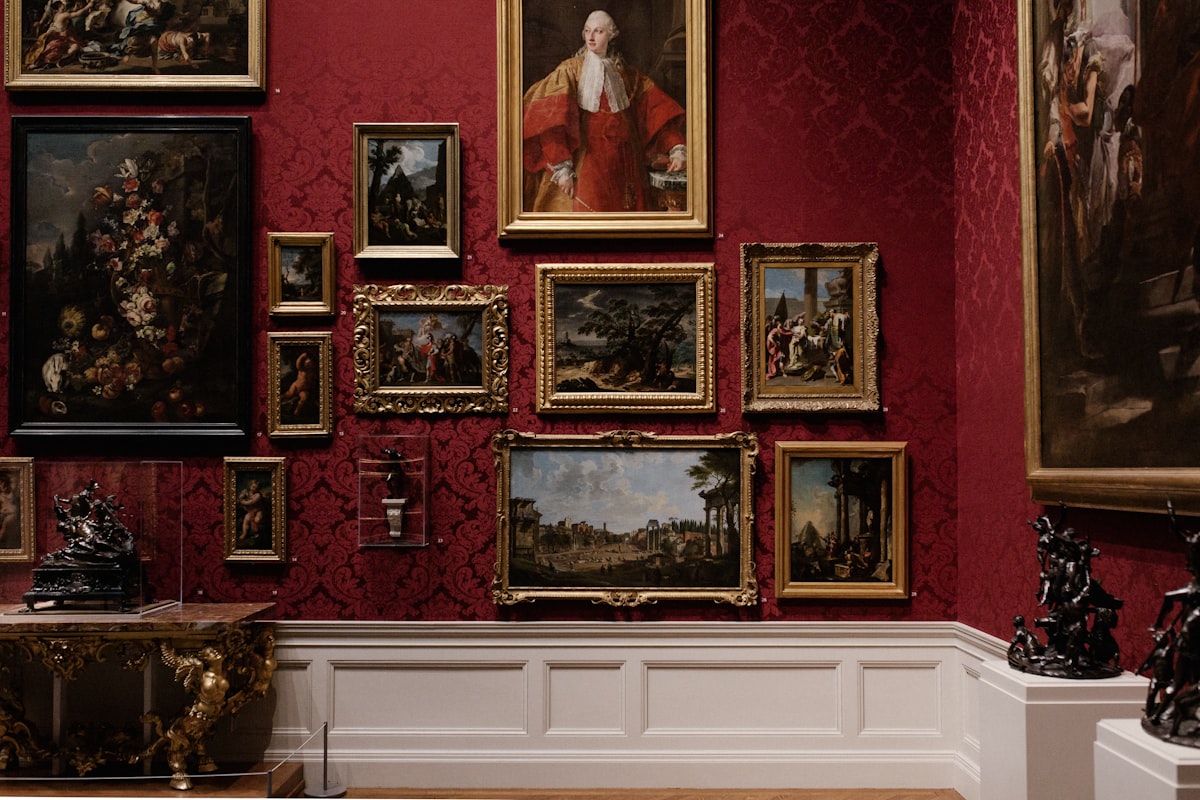
Size is the decision people get wrong most often when buying art online. A print that looks commanding on a screen arrives and turns out to be the size of a magazine. The image was never the problem — the scale was.
Here is how to choose a size with confidence, in centimetres, before you buy.
Standard print sizes at a glance
Most fine-art prints cluster around a handful of dimensions. Rough guidance on where each one belongs:
- Small (roughly 20×30 cm): desks, shelves, narrow alcoves, and the satellite pieces in a gallery wall. Viewed from within a metre or two.
- Medium (roughly 30×40 to 40×50 cm): the everyday workhorse. Bedroom walls, hallways, above a console or a desk. Also the most common size in a grouped arrangement.
- Large (roughly 50×70 cm): the smallest size that reads as a genuine focal point in a living room. Good above a sideboard or as the anchor of a mixed group.
- Extra large (70×100 cm and above): statement work. Above a sofa or bed, or alone on a large empty wall. This is where a single piece can carry an entire room.
Exact dimensions for every ArtMarket work are listed in the Details section on each product page, so you can check before ordering. Sizes vary by piece — many are photographic works with their own proportions rather than fixed poster formats.
Standard print and frame sizes chart
If you are buying a ready-made frame, it helps to know how the common metric sizes map to inches and to the "A" paper sizes frames are often sold by:
- A4 — 21 × 30 cm (about 8 × 12 in): small. Desks, shelves, gallery-wall satellites.
- A3 — 30 × 40 cm (about 12 × 16 in): the everyday workhorse. Bedrooms, hallways, above a console.
- A2 — 42 × 60 cm (about 16 × 24 in): a genuine focal point in most rooms.
- 50 × 70 cm (about 20 × 28 in): large. The smallest size that anchors a living-room wall.
- A1 — 60 × 84 cm (about 24 × 33 in): statement scale for a big wall or above a sofa.
- 70 × 100 cm and up (about 28 × 40 in): extra large — a single piece that can carry a room.
These are approximate conversions, and A-sizes and centimetre formats do not line up exactly, so always frame to the print's real dimensions rather than the nearest label. A print that falls between two standard frame sizes is a strong case for a custom mat — our framing guide covers when bespoke framing is worth it.
Sizing to the wall
Above furniture
Aim for artwork spanning two-thirds to three-quarters of the furniture width beneath it:
- 140 cm sideboard → around 90–105 cm of art
- 200 cm sofa → around 130–150 cm of art
- 160 cm double bed → around 105–120 cm of art
That total can be one piece or several hung as a set. Three 40×50 cm prints with 6 cm gaps span about 132 cm — a good fit above a standard sofa.
On an empty wall
A piece hung alone should occupy roughly 60% of the available wall width. It is very hard to go too big on a large blank wall and very easy to go too small — undersized art on a wide wall is the most common scale error in homes.
In tight spaces
In hallways, landings and narrow returns you are viewing from close range, so detail beats scale. A 30×40 cm print you pass at arm's length delivers more than a large one you can never step back from.
Above a bed, desk or dining table
- Above a bed: match the width of the headboard, not the mattress. A 150 cm double headboard wants about 100–115 cm of art — one wide piece, or a pair or trio hung as a set. Centre it on the bed, not the wall.
- Above a desk: keep it modest so it frames the workspace rather than looming over it. A single 30×40 cm print, or two small pieces, sits comfortably above a standard desk.
- Above a dining table: treat the table like furniture and aim for two-thirds of its length — but if the table can move, size to the wall behind it instead so the arrangement still works when the table is pulled out.
Portrait, landscape or square?
Orientation should answer to the wall, not just the image. Match the shape of the art to the shape of the space:
- Portrait (tall): for narrow walls, chimney-breast alcoves and the space beside a doorway. It draws the eye upward and suits rooms with lower ceilings.
- Landscape (wide): the natural fit above a sofa, bed or sideboard, where it echoes the horizontal line of the furniture.
- Square: the most forgiving format for a gallery wall or a standalone piece on an awkward wall, because it reads as balanced from any angle.
Remember the frame
The print is not the finished object. Framing adds real footprint, and a mat adds a lot:
- A 5 cm mat plus a 2 cm frame turns a 30×40 cm print into a 44×54 cm object on the wall.
- A generous mat is a design choice, not padding — it gives the image breathing room and makes a modest print read as more considered.
So when you calculate against the two-thirds rule, calculate with the framed dimensions. Our framing guide covers mat widths, glazing and frame choice in detail.
Test it before you buy
The most reliable trick costs nothing: cut a sheet of newspaper or kraft paper to the framed dimensions and tape it to the wall. Live with it for a day. You will know immediately whether it wants to be bigger — it usually does.
Pair that with our hanging height guide and you can place the piece precisely before anything arrives.
Shipping and handling for larger prints
Every ArtMarket print — regardless of size — ships unframed and rolled in a sturdy protective tube, so large pieces travel just as safely as small ones and arrive ready to frame. Standard EU delivery is typically 3–7 business days, and orders over €175 ship free.
Browse the full collection, or go straight to statement pieces if you already know the wall needs something big.
Frequently asked questions
- What are standard art print sizes in cm?
- Common fine-art print sizes cluster around 20×30 cm, 30×40 cm, 40×50 cm, 50×70 cm and 70×100 cm. Photographic works often have their own proportions, so check the Details section on each product page for exact dimensions.
- What size art should I hang above a sofa?
- Aim for artwork spanning two-thirds to three-quarters of the sofa width. Above a 200 cm sofa, that means about 130–150 cm of art — either one large piece or a group of prints whose combined width, including gaps, reaches that range.
- Does the frame change what size print I should buy?
- Yes. A 5 cm mat and a 2 cm frame turn a 30×40 cm print into a 44×54 cm object on the wall. Always apply sizing rules to the framed dimensions rather than the print alone.
- How can I test a print size before buying?
- Cut paper to the framed dimensions, tape it to the wall, and leave it for a day. It is the cheapest and most reliable way to judge scale — and it usually reveals that you want a larger piece than you first assumed.
- What size is an A2 print in cm?
- A2 is 42 × 60 cm, or roughly 16 × 24 inches. For reference, A3 is 30 × 40 cm and A1 is 60 × 84 cm. These are approximate, so frame to the print's exact stated dimensions rather than the nearest A-size label.
- What size art should I hang above a bed?
- Match the width of the headboard, not the mattress, and aim for about two-thirds of it — around 100–115 cm of art above a 150 cm double. Use one wide piece or a pair or trio hung as a set, and centre it on the bed rather than the wall.
- Is a 30×40 cm print big enough for a living room?
- On its own above a sofa, usually not — a single 30×40 cm print reads as undersized on a large wall. It works well as part of a group, or in a hallway, bedroom or above a desk where you view it from closer range.