Contemporary
Art for Modern Apartments
By Alexander van der Meer·· 5 min read
Modern apartments impose four constraints most styling advice ignores: white walls you cannot paint, open plan, not much wall, and a landlord.
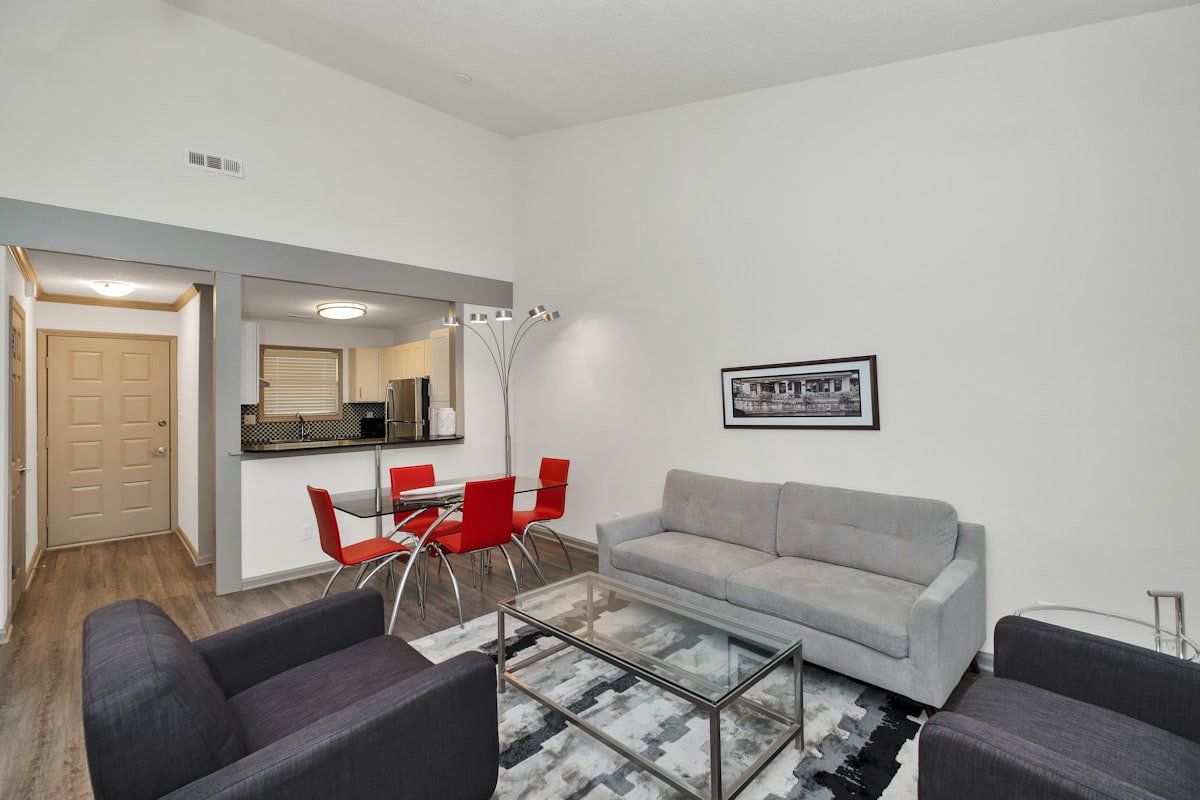
Most advice about hanging art assumes a house — separate rooms, plenty of wall, and permission to put holes in it. A modern apartment usually offers none of those, and the constraints are specific enough to be worth addressing directly.
Four of them, and each has a workable answer.
Constraint 1: white walls you cannot change
Landlord white is a genuinely difficult background — not because it is neutral but because it is bright and slightly cold, and it makes everything hung on it look like it was placed there provisionally.
Two things fix that. The first is scale: a single large piece reads as intentional on a white wall in a way that several small ones never do. The second is committing to real contrast — either a properly dark image or a genuinely saturated one. It is mid-tone work that looks tentative against bright white, because it neither stands against the wall nor recedes into it.
If the flat is small, dark and saturated is usually the better bet — it gives the eye somewhere definite to land, which paradoxically makes the room read as larger than an all-white one does.
Constraint 2: open plan means everything is seen at once
In a house you can give each room its own character. In an open-plan apartment the kitchen, dining area and living space are visible from one another, so every piece you hang is seen alongside every other piece — usually at an angle, from across the room, rather than head-on.
This argues for coherence over variety. Pick one unifying thread and hold it across all the pieces you hang: a single palette, a single medium, or a single subject family. Three works that share a register read as a considered whole; three unrelated works read as things that arrived at different times.
It also means you should choose from the doorway. Stand where you actually enter the space, and check that the piece works from there rather than from the sofa. Most viewing of a wall in an open-plan flat happens while moving through it.
Constraint 3: there is less wall than you think
Modern apartments trade wall for glazing. Large windows, balcony doors and open sightlines mean the number of walls that can actually take a piece is often two or three in the whole flat.
The consequence: do not spread your budget thinly. If you have three usable walls, three good pieces beat nine mediocre ones by a wide margin. And measure before buying — the usable width is the wall minus what furniture, radiators and light switches take out of it, which is frequently 40 cm less than the wall itself.
Narrow wall segments between windows are worth using. A tall, narrow print in a 50 cm gap is one of the few places where an unusual format is exactly right, and the size guide covers what dimensions to look for.
Constraint 4: you may not be able to drill
Several approaches, in rough order of how much weight they take.
- Picture rails, if the building has them. The best option by far and frequently overlooked in older converted flats.
- Adhesive hanging strips. Genuinely good now, and rated up to about 3 kg per pair — which covers most framed prints up to 40×50 cm. Check the wall is smooth and clean paint rather than textured or freshly painted.
- Leaning. A larger print resting on a shelf, sideboard or the floor against the wall. This reads as deliberate in a modern interior rather than as a compromise, and it is the easiest thing to change your mind about.
- Clip hangers. A print held between two wooden battens and hung from a single small nail or hook — one hole rather than four, and no frame weight.
Prints here ship unframed and rolled, which is worth noting if you are renting: an unframed print in a tube is much easier to move flats with than glazed frames, and you can decide on framing once you know where you are staying.
What to hang
Architecture and cityscape is the natural fit — it shares the vocabulary of the building you are in, and the strong lines hold up when viewed at an angle from across an open-plan room. The cityscape edit collects that work.
Minimal, high-contrast compositions are the other reliable answer, for the white-wall reasons above. See the minimalist collection.
What to be careful with: very busy images, which compete with the visual noise an open-plan space already has, and pastel work, which disappears against white walls entirely.
A sequence that works
Identify your two or three usable walls. Measure each, minus obstructions. Buy one large piece for the wall you see on entering, hang it, and live with it for a fortnight before choosing the second. Prints can be returned within 14 days if the scale turns out wrong — which, in an apartment, is the mistake worth protecting against.
Frequently asked questions
- What art works best in a modern apartment?
- Architecture and cityscape work, which shares the building's vocabulary and holds up viewed at an angle, and minimal high-contrast compositions, which read as intentional against white walls. Avoid very busy images and pastels — the first competes with open-plan visual noise, the second disappears against white.
- How do I hang art in a rental without drilling?
- Picture rails if the building has them, adhesive hanging strips rated to about 3 kg per pair for prints up to roughly 40×50 cm, leaning a larger piece on a shelf or the floor, or clip hangers that need a single small hook rather than four holes.
- How do I make art look intentional on white rental walls?
- Scale and contrast. One large piece reads as deliberate where several small ones read as provisional, and committing to either a properly dark or a genuinely saturated image beats mid-tone work, which looks tentative because it neither stands against the wall nor recedes into it.
- How should I choose art for an open-plan space?
- Prioritise coherence over variety, because every piece is seen alongside every other. Hold one unifying thread across all of them — a palette, a medium, or a subject family — and check each piece from the doorway rather than from the sofa, since that is where most viewing happens.
- How many pieces should I buy for a small apartment?
- Fewer and larger. Modern apartments trade wall for glazing, so there are often only two or three usable walls in the whole flat. Three good pieces on three walls beat nine mediocre ones, and thin-spreading a budget is the common mistake.
- What size art fits between two windows?
- A tall narrow format. Narrow wall segments are one of the few places an unusual aspect ratio is exactly right rather than a compromise. Measure the usable width — the gap minus what radiators, switches and furniture take out of it, often 40 cm less than the wall itself.